Practical guide
How to Adjust a Cornstarch Slurry: Thickness, Heat and Timing
Mix cornstarch smoothly with cold water, stir it again before use, then add it gradually and give the sauce its recipe’s heating step before judging thickness. The mixing ratio is not the dose the pan needs. Use the fraction calculator, worked examples and troubleshooting checks to keep track of dry starch instead of repeatedly pouring in more.
Separate the mixing ratio from the dose in the pan
A cornstarch slurry is a mixture of cornstarch and cool liquid used to distribute the starch before it enters a hot sauce. To adjust one, first ask two questions: how much dry cornstarch is in the prepared mixture, and how much of that mixture are you actually adding?
A 1:1 mixing ratio can mean one level teaspoon of cornstarch with one teaspoon of water. It does not mean one teaspoon of that slurry will thicken every cup of sauce correctly. Sauce quantity, existing thickeners, released vegetable water, heating and the texture you want also matter.
This guide addresses ordinary cornstarch used to finish a sauce. It does not provide a kitchen-tested recipe, a universal starch dose or a viscosity measurement. Start with a recipe suited to your dish, then use these checks for controlled adjustments.
Mix smoothly in cold liquid and stir again before use
Check the package first. In some regions the white refined starch is sold as cornflour; whole-grain corn flour or cornmeal is a different ingredient. Use the product your recipe specifies, not a similarly named ground corn product.
Measure the starch and cold mixing water in a small bowl. Stir with a clean utensil until the mixture is smooth, breaking up dry pockets before it reaches the pan. Do not scatter dry starch directly into a hot sauce and expect it to distribute evenly.
The Woks of Life uses equal volumes of starch and water as a general slurry and explicitly describes the starch as dispersed, rather than dissolved. It also notes how readily the mixture settles. Stir it again immediately before pouring; a watery top and dense bottom are not interchangeable portions.
A recipe can specify more mixing water. This site’s bok choy and mushroom sauce lists one teaspoon cornstarch with one tablespoon water: with U.S. spoon measures, that is a 1:3 mixture by volume. Its ingredient amount is a starting recipe instruction, not proof that every sauce needs that concentration.
| Mixture by volume | Cornstarch | Cold water | What changes |
|---|---|---|---|
| 1:1 | 1 level tsp | 1 tsp | Less mixing water; the dry starch amount stays 1 tsp. |
| 1:2 | 1 level tsp | 2 tsp | More mixing water; the dry starch amount stays 1 tsp. |
| 1:3 | 1 level tsp | 3 tsp | Still more mixing water; the dry starch amount stays 1 tsp. |
Use the same spoon system consistently. These examples are volume comparisons, not gram conversions. Packing a heaped spoon, changing the starch product or substituting a flour introduces another variable. Follow the actual recipe and package before converting a different thickener.
Track the portion added without pretending to predict thickness
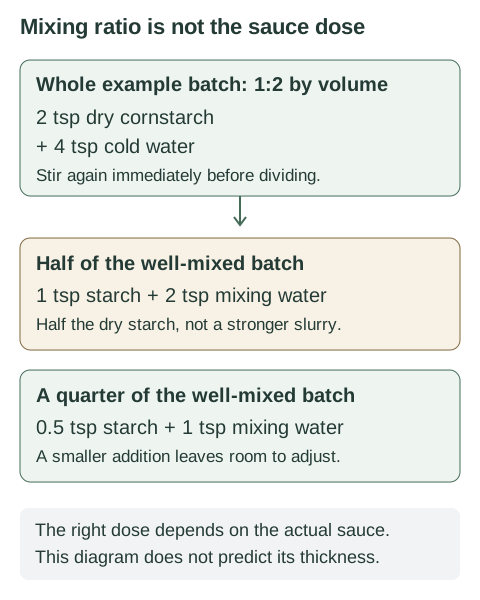
For a fictional batch of two teaspoons starch and four teaspoons water, half the well-mixed batch represents one teaspoon dry starch. A quarter represents half a teaspoon. You can prepare a batch and use only part of it; the rest does not have to enter the pan simply because you mixed it.
| Fraction of batch | Dry starch represented | Mixing water represented | Remaining dry starch |
|---|---|---|---|
| One quarter | 0.5 tsp | 1 tsp | 1.5 tsp |
| One half | 1 tsp | 2 tsp | 1 tsp |
| Three quarters | 1.5 tsp | 3 tsp | 0.5 tsp |
| Whole batch | 2 tsp | 4 tsp | 0 tsp |
Compare the mixture with the portion added
Use this arithmetic aid to track dry starch and mixing water. It does not calculate the dose your sauce needs or measure viscosity.
Whole prepared batch:
Portion added represents:
Remainder represents:
These figures assume a uniformly remixed batch and consistent spoon measures. Ingredient volumes do not necessarily add to an exact finished slurry volume; do not use the sum as a measured liquid volume. A settled, unmixed spoonful may contain a very different starch proportion.
The remaining amount is useful for keeping a record, not permission to add all of it. If the sauce reaches the texture you want after the first controlled addition, stop. Keep prepared slurry separate from raw-meat utensils and follow suitable food handling for your cooking session.
Heat the sauce before deciding on the next addition
Prepare the slurry before the final stir-fry stage so you are not measuring while garlic scorches or vegetables soften. Remix it, add a small portion in a thin stream and stir the sauce evenly to distribute it. Avoid a concentrated dump into one spot.
Argo’s basic cooking guidance recommends gradually mixing starch into cold liquid, cooking over medium-low to medium heat, stirring constantly, bringing the mixture to a full boil and boiling for one minute. It also warns that high heat can cause lumping and that substantially overcooking thickened mixtures can lead to thinning.
The Woks of Life describes using about three quarters of a recipe’s estimated slurry first, cooking a stir-fry sauce for 15–20 seconds, then checking whether more is needed. Its gravy discussion says to bring the sauce back to a simmer before judging thickness. These are different instructions for different cooking contexts, not a single guaranteed time for every pot.
Follow your recipe’s heating step and product instructions. Do not declare a sauce finished solely because the calculator produced a number, or keep pouring starch in before it has had time to thicken. Distribute a new addition with sufficient stirring, then avoid prolonged rough whisking that can damage a thickened mixture.
For delicate vegetables, consider finishing the sauce while they wait separately, then combining briefly when the sauce is ready. Cornstarch does not reverse mushy broccoli or scorched garlic. A glossy sauce is also not a test of whether any meat in the dish is safely cooked; use the applicable cooking and thermometer guidance for that ingredient.
Read the sauce, the vegetables and the target texture
For a light vegetable glaze, look for a sauce that coats without a heavy paste-like layer. A soup, gravy or sweet filling can have a different target. Decide what you want before adjusting; “thicker” is not automatically better.
Drain pre-cooked greens and allow mushrooms’ released water to cook off as directed before finishing the sauce. Otherwise, you can add starch to compensate for liquid that should have been managed earlier. Adding wetter ingredients after thickening can also change the result.
If the sauce is smooth but thin, check the heating step, the amount already added and whether extra water entered the pan. Once those checks are clear, remix the remaining slurry and add another small portion if the recipe permits. Keep a note of the cumulative dry starch rather than resetting your count with every addition.
If the sauce is too thick, stop adding starch. For a simple compatible sauce, add small amounts of unsalted stock or water, mix evenly and reassess after appropriate heating. Dilution also changes seasoning. Taste with a clean spoon only when all ingredients are safe to taste, and adjust salt or acid cautiously.
Let a small serving reach its intended eating temperature before deciding the next batch needs much more starch. The Woks of Life notes that hot gravy can thicken a little as it cools. That is a texture check during normal service, not a reason to leave food sitting out for an extended period.
Troubleshoot lumps, thinning and a gummy finish
| Observation | Check first | Controlled next move |
|---|---|---|
| Powdery lumps appear on contact | Was dry powder tipped into hot liquid, or was the slurry already lumpy? | For a simple sauce, strain if practical, then add a freshly smooth cold slurry gradually. |
| Smooth but thin immediately after adding | Has the recipe’s heating step happened, and did the slurry settle? | Stir in evenly, complete the specified cooking step, then reassess. |
| Sauce is thick while vegetables are soft | Are the vegetables waiting through repeated sauce adjustments? | Finish the sauce separately when practical; avoid prolonged vegetable cooking. |
| Gummy or paste-like sauce | How much dry starch has already gone in, and how little liquid remains? | Add compatible liquid in small amounts; reassess seasoning and texture. |
| Sauce thickened, then became thin | Extended cooking, rough stirring, acid, sugar, fat or newly released water? | Identify the change before repeating the same starch dose. |
| Texture changes after freezing | Was ordinary cornstarch used in a cooked sauce? | Expect possible thinning; use a recipe designed for the intended make-ahead method. |
Not every thin sauce needs more starch. Argo identifies too little liquid, high sugar or fat levels, acid, excessive stirring, extended cooking and freezing among possible influences on a thickened mixture. Those factors are especially relevant when a sauce seemed thick during cooking and changed later.
When adapting an acidic sauce, use a recipe designed for that balance and follow its ingredient sequence. Argo suggests adding acid after cooking or adjusting starch slightly where appropriate. That is not a reason to remove all acid from a recipe or blindly multiply its starch.
For ordinary cornstarch, a good hot texture does not establish freeze-and-thaw stability. Argo warns that cooked cornstarch mixtures can thin after freezing. Choose a make-ahead recipe and product suitable for the intended method instead of promising that every frozen sauce will reheat unchanged.
If lumps remain in a simple sauce, straining may be practical, but it can remove useful ingredients as well. A separately prepared replacement sauce may be preferable for a severely lumpy or burnt result. Do not claim that more slurry can reliably repair scorched flavor, damaged vegetables or unsafe food handling.
Six decisions to practise before the pan gets busy
These fictional cases test ingredient proportions and the next useful cooking check. Their arithmetic is exact for the stated ingredients; their texture guidance is source-based and has not been kitchen-tested here.
Case 1
Two cooks each mix 1 tsp cornstarch. One uses 1 tsp cold water; the other uses 3 tsp. If both use their entire batches, did the first add three times the starch?
Show answer and explanation for case 1
No. Each whole batch contains 1 tsp dry starch.
The mixing ratio describes water relative to starch, not the dry starch amount added to the pan. The second batch contributes more mixing water, which can affect the final sauce as well. Compare the dry starch, all liquid and sauce conditions rather than treating a 1:1 label as a universal stronger dose. This is an arithmetic comparison, not evidence that the two finished sauces will be identical.
Case 2
A uniform batch contains 2 tsp starch and 4 tsp water. You add one quarter. How much starch does that addition represent?
Show answer and explanation for case 2
0.5 tsp dry starch, with 1 tsp mixing water.
Multiplying both ingredients by one quarter preserves the batch’s 1:2 ratio while reducing its dose. The remaining three quarters contain 1.5 tsp starch and 3 tsp water. These are ingredient proportions; they are not a claim that the mixture has an exactly additive finished volume. Stir again immediately before dividing because starch can settle into a dense layer.
Case 3
The slurry bowl has clear water over a dense white layer. Can a spoon from the top be counted as a uniform portion?
Show answer and explanation for case 3
No. Remix the batch until it is smooth and evenly dispersed.
Settling changes what an individual spoonful contains. The calculator assumes a uniform mixture, so its arithmetic cannot describe an unmixed watery top or concentrated bottom. Use a clean utensil to loosen and recombine the starch, check for dry pockets, then add the slurry gradually while stirring the sauce. Do not compensate for a watery top by dumping the dense bottom into the pan.
Case 4
A vegetable sauce still looks thin seconds after the first addition. Should you immediately pour in all the remaining slurry?
Show answer and explanation for case 4
Complete the recipe’s heating step and reassess before adding more.
Newly added cornstarch needs heat to thicken; an immediate appearance is not the final result. Published timings differ: Argo gives a full boil and one minute for its basic method, while The Woks of Life describes a brief stir-fry check before deciding on another addition. Follow the method appropriate to your sauce. Keep delicate vegetables out of a prolonged adjustment when practical, and track the starch already used.
Case 5
The sauce was glossy, then became thin after a long simmer with vinegar. Does that prove the original slurry had too little starch?
Show answer and explanation for case 5
No. Cooking time and acid are separate possibilities to check.
Argo identifies extended cooking and acidic ingredients among factors that can reduce thickening. Newly released vegetable water can also dilute a sauce. Check what changed rather than repeating the same starch addition without a limit. For a new attempt, follow a suitable recipe’s sequence, reserve acid for its specified stage and use a controlled addition. Increasing starch alone does not undo scorched flavor or restore overcooked vegetables.
Case 6
A sauce is gummy after several additions, and the broccoli is already tender. What is the more controlled next step?
Show answer and explanation for case 6
Pause starch additions and adjust the sauce with a little compatible liquid.
A small addition of unsalted stock or water can dilute an overly concentrated simple sauce, but it also changes flavor. Mix evenly, heat as needed and check seasoning rather than pouring in an unmeasured large amount. Remove delicate vegetables while adjusting when practical. If the sauce is badly lumpy, burnt or separated, a separate fresh sauce may be more useful than repeatedly adding ingredients to a failing pan. This is troubleshooting guidance, not a tested recovery promise.
Keep a small record for a more controlled next attempt
Record the starch product, level-spoon amount, mixing water, total fraction added, sauce ingredients and whether vegetables were drained. Add the heating sequence and what changed after the first addition. A note such as “used half of a 2 tsp + 4 tsp batch” is more informative than “added some slurry.”
On the next attempt, change one factor at a time. If the vegetables released excess water, address that step before increasing starch. If the sauce became gummy, start with a smaller fraction and keep the heating check consistent. If a different starch or bottled sauce was substituted, record it rather than assuming the same result.
Download the original ratio examples and cooking record for a short worksheet you can keep beside the recipe. It contains no measured viscosity or promise that a particular dose will produce a specific coating.
For an actual dish, return to the bok choy and mushroom sauce recipe. For color and seasoning choices that the starch cannot solve, use the light versus dark soy sauce guide. Keep sauce thickness, flavor, vegetable texture and food safety as separate decisions.
Sources and further reading
- Argo: Frequently Asked Questions — Cooking/PreparationManufacturer’s cold-liquid mixing, heating guidance and cautions about lumps, extended cooking, acid, sugar, fat, stirring and freezing; used with scope appropriate to the dish.
- The Woks of Life: How to Use Cornstarch in Chinese CookingBill Leung’s 1:1 slurry by volume, settling and remixing, partial additions, stir-fry versus gravy checks and cooking by the actual sauce texture.