Practical guide
Plum Sauce vs Hoisin: Dips, Glazes and the Rest of the Sauce
Plum sauce supplies a sweet-tart fruit direction; hoisin supplies a sweet-savory bean-and-spice direction. Read the exact labels and the rest of the sauce before substituting. A published plum skewer marinade also contains oyster sauce, chili-garlic sauce and lime, and divides the mixture before raw pork touches it.
On this page
Decide dip versus cooked coating
For a dip served beside cooked food, the condiment’s flavor is prominent and diners control the amount. For a glaze or marinade, its sweetness, acidity and body interact with the other ingredients and the cooking stage. Start by deciding which of those jobs your missing sauce performs.
If you want hoisin’s sweet-savory bean-and-spice character, plum sauce makes a different dip. If you want a sweet-tart fruit sauce, adding more soy to a hoisin dip does not supply the missing fruit or acidity. Choosing a different established dip is often more useful than chasing an exact match.
Compare the exact plum and hoisin ingredients
On a phone, scroll inside the table. Keyboard users can focus the table region and use arrow keys.
| Question | Plum Sauce example | Hoisin Sauce example |
|---|---|---|
| Fruit, beans and spices | Salted plums, ginger and chili peppers listed | Fermented soybean paste, sesame paste, garlic and spices listed |
| Sweetening and acidity | Sugar, rice vinegar and citric acid listed | Sugar and acetic acid listed among other ingredients |
| Body | Modified corn starch and xanthan gum listed | Modified food starch and sweet potato powder listed |
| Dietary information | Published allergen field says soybeans and wheat although those are not explicit in the displayed ingredient list | Sesame, soybeans and wheat are declared and corresponding ingredients are listed |
The plum page’s conflicting fields are a reason to verify the actual package or ask the manufacturer when an ingredient must be avoided. Do not decide it is soy-free or wheat-free by deleting the allergen field from the comparison. The listed thickeners also do not provide a tested viscosity or spoon conversion.
Audit the published skewer sauce
The manufacturer’s BBQ Pork Skewers with Plum Sauce combines 6 tablespoons plum sauce, 2 tablespoons oyster-flavored sauce, 2 tablespoons chili-garlic sauce and 1 tablespoon lime juice. It uses half of that mixture to marinate 1 pound of cubed pork and reserves the remainder for basting during grilling.
This trace answers an important question: “plum sauce” in a recipe title does not mean the coating is pure plum sauce. Removing oyster sauce or replacing plum with hoisin changes a multi-ingredient mixture. The quantities above are attributed to that recipe, not a new kitchen-tested glaze or a recommendation to use 6 tablespoons of any sweet sauce.
Source details: [3].
Separate raw-contact and clean sauce
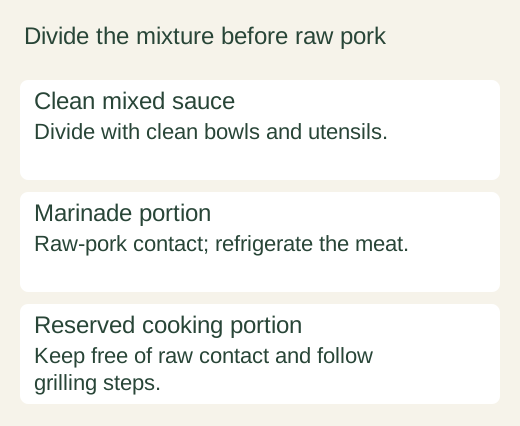
Download the labelled decision diagram
Prepare the mixture in a clean bowl, divide it before adding raw pork, and keep the reserved portion separate. A brush that touches partly cooked pork can contaminate sauce; do not then treat that bowl as a ready-to-serve dip. If you want a serving sauce, reserve another clean portion before raw contact.
FDA guidance says to marinate in the refrigerator and not reuse raw-contact marinade unless it is brought to a boil first. Its whole-cut pork endpoint is 145°F, about 63°C, followed by a three-minute rest. A caramel-colored coating or the recipe’s estimated grilling time cannot replace checking the food. Follow appropriate guidance for the actual cut and preparation.
Source details: [4].
Choose a deliberate adaptation
- Identify whether the sauce is a dip, marinade, basting mixture or finishing glaze.
- Read every sauce and acid in the complete formula, not only the title.
- Check the exact products for dietary needs; resolve conflicting label information first.
- Select a recipe designed for the sauce you have, or recognize an adaptation without claiming an equal-volume flavor match.
- Separate clean sauce before raw food and keep cooking safety independent from glaze color.
“Duck sauce” is a product or serving name, not enough evidence that every bottle is the plum product compared here. Read its ingredients and intended use. Nor does the presence of vinegar give a homemade diluted mixture the unopened bottle’s shelf life.
Three explained dip and glaze decisions
The following cases are hypothetical label and handling decisions, not tested flavor comparisons.
Case 1
You want a hoisin dip for cooked wraps but only have plum sauce. Is the plum dip identical?
Show answer and explanation for case 1
No. It is a different sweet-tart fruit choice.
The named plum and hoisin products have different main ingredients. Serve it because that flavor suits the meal, or choose a suitable hoisin; do not claim an invisible substitute.
Case 2
The plum web ingredient list does not explicitly name wheat, but its allergen field does. Can you call the product wheat-free?
Show answer and explanation for case 2
No. Resolve the exact package or manufacturer information.
The contradiction is unresolved evidence, not permission to choose the reassuring field. This guide does not certify allergy suitability.
Case 3
Half the skewer sauce touched raw pork. Can it become a cold dip because the other half was reserved?
Show answer and explanation for case 3
No. Track each portion and its utensils separately.
Reserving one clean portion does not clean the raw-contact portion. FDA handling rules and complete cooking still apply; basting utensils can also transfer raw contact.
Sources and further reading
- Lee Kum Kee USA: Plum SauceNamed US product ingredients and stated uses, checked November 11, 2026. Regional formulas and your current package can differ.
- Lee Kum Kee USA: Hoisin SauceNamed US product ingredients and stated uses, checked November 11, 2026. Regional formulas and your current package can differ.
- Lee Kum Kee USA: BBQ Pork Skewers with Plum SaucePublished recipe used to examine its sauce components and sequence; missing or ambiguous quantities are discussed where relevant. Attributed amounts are not a general substitution ratio.
- FDA: Safe Food HandlingFood handling, safe cooking endpoints, refrigerated marinating and prompt cooling. FDA document captured November 7, 2026.