Practical guide
Sweet Bean Sauce, Ground Bean Sauce or Hoisin: Choose for the Dish
Choose these bean sauces by the job they do in the dish. Named sweet bean, ground bean and hoisin products have different ingredient lists. A small allowed supporting swap in twice-cooked pork does not make them interchangeable with the main spicy paste or with every sauce in a recipe.
On this page
Choose the job before the name
First locate the sauce in the complete recipe. Is it the main coating, a small supporting seasoning, or a dip served beside cooked food? That distinction is more useful than the shared word “bean.” A sauce that works as a teaspoon-sized optional addition may change a dish substantially when it becomes the whole sauce.
Our twice-cooked pork formula allows 1 teaspoon of sweet bean sauce or hoisin as a supporting ingredient. The main fermented chili paste is still measured separately. That specific option does not authorize replacing all the doubanjiang with hoisin.
Read three exact product labels
On a phone, scroll inside the table. Keyboard users can focus the table region and use arrow keys.
| Product | What the manufacturer lists | Useful distinction |
|---|---|---|
| Sweet Bean Sauce, 90 g tube | Fermented soybean paste containing wheat flour, sugar, sesame paste, soy sauce and modified corn starch | Already a blended sweet-savory sauce; soybeans, wheat and sesame declared. |
| Ground Bean Sauce, 368 g jar | Water, sugar, salt, soybeans, wheat flour, flavor enhancer and modified corn starch, among other ingredients | A ready cooking condiment; this example is not plain ground beans. |
| Hoisin Sauce | Sugar, fermented soybean paste containing wheat flour, sesame paste, sweet potato powder, spices and other ingredients | Its own sweetened, spiced sauce profile; soybeans, wheat and sesame declared. |
These are three products from one manufacturer, not definitions of every regional sauce. “Sweet bean sauce” does not tell you whether another brand has sesame, the same grain ingredients or the same sweetness. Nor does the order of ingredients provide a verified sodium amount or a taste-test score.
Trace the ground-bean chicken example
Lee Kum Kee’s Stir-Fried Chicken in Ground Bean Sauce lists 8 ounces of chicken, onions, asparagus and baby corn, 2 tablespoons of cooking oil and 2 tablespoons of its Ground Bean Sauce. The method cooks the ingredients, then adds the sauce and heats it through. It does not list hoisin, chili bean paste or a separate soy-sauce finish.
The useful lesson is the location and role of the condiment. The two-tablespoon quantity belongs to that particular recipe. It is not a conversion between ground bean sauce and hoisin, and the stated four-serving yield does not tell you how much another meal needs. Follow a complete recipe that fits your ingredients and use a food thermometer for chicken: 165°F, about 74°C.
Understand the small pork-recipe option
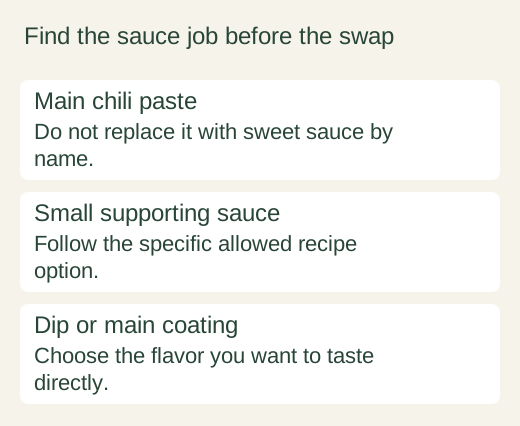
Download the labelled decision diagram
In twice-cooked pork, the permitted sweet sauce accompanies doubanjiang, optional douchi, light soy and a separately measured half-teaspoon of sugar. If your jar is unfamiliar, do not add another unmeasured squeeze for color. The recipe already contains several seasoning sources.
For a dip, the sauce is more prominent. A hoisin dip changed to another bean sauce can need a different complete dip formula. Decide whether that changed flavor is welcome rather than trying to prove an invisible swap with sugar and soy sauce. The existing hoisin guide covers general dips, glazes and jar care.
Adapt without an automatic conversion
- Read the exact recipe and identify its named sauce and role.
- Check the complete current package for ingredients, dietary needs and storage directions.
- Record other sugar, soy sauce, stock and fermented pastes before changing anything.
- Use a recipe that explicitly permits your product, or choose a complete recipe designed for it. Keep optional finishing additions uncommitted.
- Complete safe cooking before tasting a small portion with a clean utensil; record your actual adjustment.
Adding water loosens a sauce but does not remove the salt already present. Boiling that water away concentrates it again. Sauce color and thickness also do not establish safe meat doneness. Keep a change in flavor separate from the cooking endpoint.
Three explained shopping and cooking decisions
These situations are constructed to practise a choice; they are not reports of meals we cooked.
Case 1
The pork recipe permits 1 teaspoon hoisin beside 1½ tablespoons doubanjiang. You only have hoisin. Can it replace both?
Show answer and explanation for case 1
No. The stated option covers the supporting teaspoon, not the main chili paste.
The quantities have different jobs. Buy a suitable main paste or choose another complete recipe; a shared fermented-bean ingredient does not supply the same chili character.
Case 2
A jar says Ground Bean Sauce. Should you treat it as plain beans and add the usual full soy-sauce formula?
Show answer and explanation for case 2
Read it as a mixed condiment and choose the matching recipe first.
The named jar already lists salt and sugar among its ingredients. Its name does not reveal a seasoning-neutral ingredient, and no universal extra-soy amount follows from it.
Case 3
Both the sweet bean tube and hoisin are labeled vegan. Does that settle wheat or sesame avoidance?
Show answer and explanation for case 3
No. Check those requirements separately on the current package.
The named examples declare soybeans, wheat and sesame. Vegan describes a different requirement; it is not a guarantee for an allergy or gluten restriction.
Sources and further reading
- Lee Kum Kee USA: Sweet Bean SauceNamed US product ingredients and stated uses, checked November 11, 2026. Regional formulas and your current package can differ.
- Lee Kum Kee USA: Ground Bean SauceNamed US product ingredients and stated uses, checked November 11, 2026. Regional formulas and your current package can differ.
- Lee Kum Kee USA: Hoisin SauceNamed US product ingredients and stated uses, checked November 11, 2026. Regional formulas and your current package can differ.
- Lee Kum Kee USA: Stir-Fried Chicken in Ground Bean SaucePublished recipe used to examine its sauce components and sequence; missing or ambiguous quantities are discussed where relevant. Attributed amounts are not a general substitution ratio.
- FDA: Safe Food HandlingFood handling, safe cooking endpoints, refrigerated marinating and prompt cooling. FDA document captured November 7, 2026.