Practical guide
Fermented Shrimp Sauce vs Douchi: Two Different Savory Ingredients
Fermented shrimp sauce and douchi are different ingredients. The named finely ground shrimp sauce contains fermented shrimp and salt; douchi are fermented black soybeans. A published tomato fish sauce uses shrimp sauce alongside chili-garlic sauce, not instead of it. Choose by ingredient, dietary needs and the complete recipe rather than a shared savory description.
On this page
Identify the exact shrimp product
“Shrimp sauce” can refer to different products. Here the example is Lee Kum Kee Shrimp Sauce (Finely Ground), whose displayed ingredient list is fermented shrimps and salt. The page declares shrimps and naturally present sulfites and describes use in marinades, steaming and stir-frying.
Those facts apply to this named fermented condiment. They do not describe every pink dipping sauce, dried shrimp packet, regional shrimp paste or shrimp-containing chili jar. Read the complete product name and current package before choosing a recipe or a quantity.
Source details: [1].
Separate fermented seafood and beans
On a phone, scroll inside the table. Keyboard users can focus the table region and use arrow keys.
| Ingredient | What it is in this comparison | Why the name does not give a swap |
|---|---|---|
| Finely ground shrimp sauce | Named fermented shrimp-and-salt condiment | Seafood ingredient; not vegetarian or a substitute for chili heat by itself |
| Douchi | Salted fermented black soybeans, described in the existing pantry guide | Soybean seasoning; ordinary canned black beans are different |
| Oyster sauce | A mixed oyster-extract seasoning or a separately identified vegetarian alternative | Different base, sweetness and body; check the complete label |
| Chili Garlic Sauce | Named chili, garlic, vinegar and other seasoning mixture | Its displayed list is a different flavor base from fermented shrimp |
A recipe can use more than one of these ingredients. “Savory” and “fermented” describe useful features but do not define the same food or a safe equal-spoon measure. The douchi preparation guide remains the place for loose-bean rinsing and chopping.
Source details: [2].
Trace the tomato fish sauce
The manufacturer’s Pan-Fried Fish with Shrimp Sauce and Chili lists 1 cup tomatoes, shallots, 1 tablespoon Chili Garlic Sauce, 1 teaspoon Shrimp Sauce (Finely Ground), 1 teaspoon tamarind concentrate and 2 teaspoons sugar in its sauce mixture. It cooks the shallots first and then simmers the mixture until the tomatoes are cooked and the sauce thickens slightly.
The sauce is prepared separately from the fish, then placed on the plate beneath the cooked fillet. Its single teaspoon of shrimp sauce is a supporting part of this particular tomato mixture. It is not a suggested teaspoon for every fish, noodle or vegetable dish, and it does not prove that one tablespoon of another condiment has equal strength.
This is an attributed fusion recipe example, not our own tested fish sauce. Consult its complete formula for the food, coating and cooking steps; do not reconstruct a new recipe from the sauce excerpt alone.
Source details: [3].
Avoid borrowed quantities and safety cues
Download the labelled decision diagram
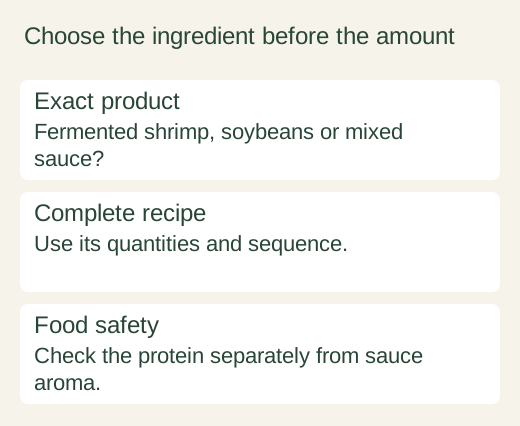
If a recipe asks for douchi, replacing them with fermented shrimp changes the ingredient family and flavor direction. If it asks for chili-garlic sauce, shrimp sauce does not reproduce its chili, garlic and vinegar combination. Select a complete recipe designed for your available condiment rather than borrowing a teaspoon from the tomato example.
A fermented condiment does not establish safe fish doneness, preserve cooked rice or make a raw-contact marinade safe to taste. FDA guidance gives finfish 145°F, about 63°C, or opaque flesh that separates easily with a fork. Its shrimp guidance calls for pearly, opaque flesh. Use the endpoint appropriate to the actual food, not the word “shrimp” in a seasoning name.
Source details: [4].
Choose by diet and cooking role
A vegetable dish made with this shrimp sauce still contains shrimp. A soy-based douchi sauce is another option only if it fits the intended recipe and everyone’s dietary requirements; it is not an allergy-neutral ingredient. Prepared bean sauces can contain wheat or other added ingredients, and other seafood sauces can contain additional allergens.
Keep the current label and storage instructions. Use clean utensils, keep raw-food contact away from ready serving sauce and refrigerate perishable prepared meals promptly. The original commercial jar’s instructions do not give a shelf life for a new tomato mixture or a cooked meal.
When the distinctive fermented seafood flavor is central and unsuitable for a diner, choosing another complete sauce recipe is clearer than claiming to remove it through a small soybean swap. The goal is a useful meal decision, not proving that all savory condiments can replace one another.
Three explained fermented-seasoning decisions
These are constructed ingredient decisions, not sensory trials or measured product rankings.
Case 1
A black-bean recipe asks for douchi. Is fermented shrimp sauce the same ingredient because both taste savory?
Show answer and explanation for case 1
No. One is a fermented soybean seasoning; the named other is shrimp and salt.
The ingredient family, dietary suitability and intended flavor change. Choose a complete recipe for the product you have rather than an automatic equal-spoon swap.
Case 2
The tomato fish sauce uses 1 teaspoon fermented shrimp sauce with 1 tablespoon chili-garlic sauce. Does that prove a 1:3 replacement ratio?
Show answer and explanation for case 2
No. They are two components in one complete recipe.
The measures do not test equivalence or define a cross-product strength ranking. Removing either changes a different part of the sauce.
Case 3
You use only vegetables with this shrimp condiment. Can you call the dish vegetarian because no whole shrimp are visible?
Show answer and explanation for case 3
No. The condiment itself contains fermented shrimp.
Visibility and portion size do not change ingredients. Check the sauce as well as the main food when choosing a suitable complete meal.
Sources and further reading
- Lee Kum Kee USA: Shrimp Sauce (Finely Ground)Named US product ingredients and stated uses, checked November 11, 2026. Regional formulas and your current package can differ.
- Lee Kum Kee USA: Chili Garlic SauceNamed US product ingredients and stated uses, checked November 11, 2026. Regional formulas and your current package can differ.
- Lee Kum Kee USA: Pan-Fried Fish with Shrimp Sauce and ChiliPublished recipe used to examine its sauce components and sequence; missing or ambiguous quantities are discussed where relevant. Attributed amounts are not a general substitution ratio.
- FDA: Safe Food HandlingFood handling, safe cooking endpoints, refrigerated marinating and prompt cooling. FDA document captured November 7, 2026.