Practical guide
Fresh vs Dried Noodles by Weight: Measure the Portions
Do not replace fresh noodles with the same weight of dried noodles by habit. First identify the exact product and whether it is raw or heat-treated. Use its preparation directions, then compare amounts at the same cooked-and-drained stage. Your own measured yield can guide portions; it cannot promise equal flavor, nutrition or sauce absorption.
Read what the weight actually describes
A recipe’s “200 g noodles” is incomplete unless you know whether it means dried noodles, fresh raw noodles, a heat-treated pack or cooked noodles. Water already present and water taken up during preparation affect the weight. Changing the product while keeping only that number can change the amount of food you serve.
Twin Marquis separates raw and heat-treated noodles in its manufacturer range. Its specific Lo Mein Noodles page marks the product RAW, lists egg and wheat, and says to boil before stir-frying. The product family therefore does not justify skipping preparation. The page does not give a verified dry-to-fresh conversion or a complete minute-by-minute cooking label.
Check the current packet’s ingredients, storage and full cooking directions. Width and intended dish matter as well. For the ingredient-family decision, use the glass-noodle and rice-vermicelli guide. This page addresses how much to allocate after you have chosen a suitable product.
Choose a common comparison stage
| Record | Write down | Why it matters |
|---|---|---|
| Starting product | Exact pack; raw, heat-treated or dried; starting grams | The denominator must describe this product. |
| Preparation | The packet’s method and any recipe finishing stage | A yield is only comparable under the method recorded. |
| Comparison stage | Cooked and drained, before sauce or toppings | Sauce, meat and vegetables add separate weight. |
| Draining | Use the same practical draining procedure each time | Clinging water can change the scale reading. |
| Target | Cooked noodle grams per intended portion | This is a portion decision, not a nutrient equivalence. |
For a soup, weigh the prepared noodle portion before adding broth. For a stir-fry, a comparison before the sauce stage is often easier to record. Keep the actual recipe’s finishing instructions; weighing does not authorize an extra full boil. If two products cannot be prepared to a comparable stage for that dish, use their serving guidance or choose a recipe written for the replacement.
Make a small yield record before changing the whole meal
- Read the complete replacement instructions and choose a suitable preparation amount.
- Weigh that starting amount on a kitchen scale and record the unit and product state.
- Prepare it by the current product directions. Do not taste raw noodles to assess doneness.
- Drain by a stated repeatable procedure and weigh the noodles without the container, sauce or toppings.
- Record the yield factor, then use the cooked portion in the intended meal or handle it promptly as cooked food.
Yield factor = cooked-and-drained noodle grams ÷ starting noodle grams. The numerator and denominator both use grams but describe different stages. A factor measured for one pack, method and draining procedure should not be silently transferred to another noodle.
The BCcampus conversion chapter supports calculating required yield against an original yield and checking adjustments in practice. Our noodle-specific record applies that general accounting method. A recipe conversion factor does not supply a manufacturer’s noodle yield. Keep your exact product and draining method with the measurement before reusing it.
An empty, zero or negative starting weight cannot give a usable yield factor. A zero prepared amount also needs the record checked before division. Keep both measured amounts positive and use the same stated stage.
Work through a constructed quantity example
| Product in this example | Starting amount | Cooked-and-drained amount | Yield factor |
|---|---|---|---|
| Fictional dried noodle A | 100 g dry | 240 g | 240 ÷ 100 = 2.4 |
| Fictional fresh noodle B | 200 g fresh | 260 g | 260 ÷ 200 = 1.3 |
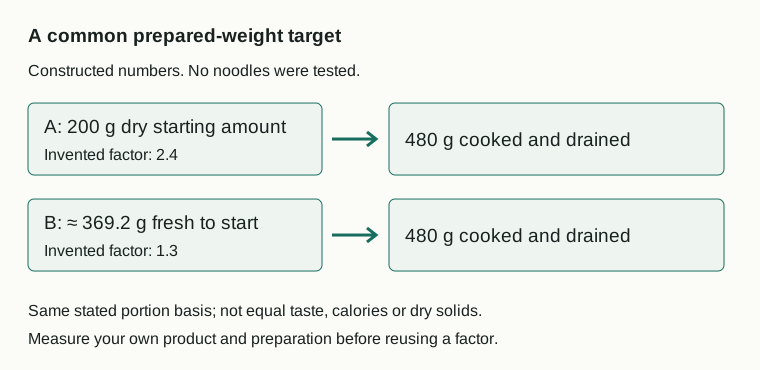
Suppose the portion plan calls for 480 g cooked-and-drained noodles, split into four 120 g portions. Using only the invented log above, A’s starting baseline is 480 ÷ 2.4 = 200 g dry. B’s is 480 ÷ 1.3 ≈ 369.2 g fresh. These figures are constructed inputs, not a recommendation for a real brand.
The same 200 g starting quantity would give 480 g for A and 260 g for B under these fictional factors. That is why copying the original starting weight is insufficient. A real yield can differ; prepare a manageable batch and use the new record rather than treating the decimal as a guarantee.
Matching 480 g of prepared noodles matches the stated portion basis. It does not establish equal dry solids, calories, protein, texture or seasoning needs. Keep any sauce adjustment separate and record it after safe cooking.
Keep sauce, package servings and storage separate
Do not scale every sauce ingredient by the fresh-to-dry starting-weight difference. The dish’s portion count and desired coating remain separate decisions. A replacement can absorb or carry sauce differently. Use the recipe-scaling guide if the number or size of portions changes; use a measured small adaptation when the noodle identity changes.
A package nutrition serving can refer to an uncooked amount or a prepared state. FDA guidance says nutrient amounts apply to the stated serving. Equal cooked weights do not automatically make equal label servings. Read the panel rather than converting calorie numbers using an invented yield.
Follow the current product’s chilled-storage requirements. Keep raw meat and its utensils separate from the noodle record and finished food. FDA guidance calls for prompt refrigeration of perishables and shallow containers for large leftovers; do not use a lengthy counter hold to make the scale reading settle. The record is a planning aid, not a food-safety test.
Four checks before substituting
These original constructed cases use the numbers above or explicitly missing information.
Case 1
The invented dried noodle has a factor of 2.4. How much starts a 480 g cooked portion plan?
Show answer and explanation for case 1
200 g dry.
480 ÷ 2.4 = 200. The result belongs to the fictional measured method, not every dried noodle.
Case 2
Both packets say lo mein. Can you assume both go directly into the stir-fry?
Show answer and explanation for case 2
No; identify raw versus heat-treated and read the packet.
The named Twin Marquis raw Lo Mein product says to boil before stir-frying. A product name alone does not specify its starting state.
Case 3
The fresh example weighs 310 g after adding 50 g sauce. Can 310 ÷ 200 be entered as its noodle yield?
Show answer and explanation for case 3
No. Use the 260 g noodle-only comparison weight.
The 50 g sauce changes the numerator. Keep the cooked-and-drained noodle stage separate.
Case 4
There is no measured yield for your replacement packet. Is 369.2 g a verified amount?
Show answer and explanation for case 4
No. Use the packet or make your own small record.
The figure comes from fictional factor 1.3. It cannot unlock an unmeasured product.
Keep the record with the exact product
Download the blank noodle yield record. It asks for the starting state, grams, preparation, draining stage, target portion and actual result. Leave measured yields blank until you have measured them. Repeat the same useful comparison stage on your next attempt, then decide whether to keep the adaptation or choose a recipe designed for that noodle.
Sources and further reading
- Twin Marquis: ProductsManufacturer separation of raw and heat-treated noodles; no conversion factor claimed.
- Twin Marquis: Lo Mein NoodlesRAW product status, egg/wheat declarations and boiling before stir-frying; not a complete cooking label.
- The Woks of Life: Chinese Noodles and WrappersFresh and dried formats and different intended uses; no universal conversion or preparation time adopted.
- BCcampus: Converting and Adjusting Recipes and FormulasRequired-yield/original-yield accounting and practical verification; chapter text snapshot dated1 November2026. No manufacturer yield supplied.
- FDA: How to Understand and Use the Nutrition Facts LabelNutrients apply to the stated serving; not a measured nutrition equivalence.
- FDA: Safe Food HandlingClean/separate handling and prompt refrigeration.