Practical guide
Scaling Chinese Recipes: Salt, Sauce and Water Adjustments
Calculate a measured ingredient baseline from the yield you need, then keep adjustable finishing seasoning and extra liquid visible. Use a two-to-six-portion noodle example, an original pan-depth diagram and a per-batch record to separate quantity arithmetic from the actual cooking result. Eight explained cases and a downloadable worksheet help you repeat a documented adjustment.
Start with the yield and portion size
To double a recipe, first double the amount of food you intend to serve. If the portion size stays the same, the ingredient conversion factor is the new number of portions divided by the original number. The BCcampus conversion guide uses this method and separately cautions that seasoning and equipment can require practical adjustments.
Conversion factor = required yield ÷ original yield
Measured ingredient baseline = original quantity × factor
Two portions to six equal-size portions gives a factor of three. Four to eight gives two; four to two gives one half. Write the original yield before changing a spoonful. A dish served with rice and other dishes may have a different portion expectation from the same dish served alone.
If portion size changes, compare total yields in matching units. Four fictional 200 g portions total 800 g. Six 150 g portions total 900 g, so the factor is 900 ÷ 800 = 1.125. A 100 g ingredient has a 112.5 g baseline. Those stated yields are arithmetic inputs, not a prediction that every cooked recipe retains the same weight.
Keep the original ingredient identity, preparation and measurement system. Weigh a gram quantity in grams; scale a level teaspoon using the same spoon system. Do not invent a grams-per-spoon conversion for a paste or assume that U.S. and imperial cups are identical.
Make a complete baseline before choosing the cooking arrangement
The ants climbing a tree guide provides a suggested, untested formula for about two main-dish portions. Its noodles, pork, paste and water illustrate the calculation below. This is a selection of ingredient lines for arithmetic; return to that page for the complete ingredient list, preparation and cooking method.
| Selected ingredient | Original formula | Factor-three baseline | Check before cooking |
|---|---|---|---|
| Dried glass noodles | 100 g | 300 g | Prepare by the package; record the actual cooked texture. |
| Ground pork | 150 g | 450 g | Keep the same meat category and complete safe cooking. |
| Unsalted stock or water | About 250 mL, plus extra as needed | About 750 mL baseline, with extra recorded separately | This is an ingredient baseline, not a prediction of absorption or evaporation. |
| Doubanjiang | 1–2 tsp to start | 3–6 tsp calculated range | Use the same spoon system and bottle; keep optional finishing additions separate. |
| Soy sauce | 1 tsp to start | 3 tsp calculated baseline | Account for the paste and stock before adding optional salt. |
| Scallions | 2 | 6 | Keep the recipe’s preparation and stage; approximate sizes can differ. |
Approximate quantities remain approximate after multiplication. “About 250 mL, plus extra as needed” becomes about 750 mL as a planning baseline, with any extra measured and written separately. It does not become an instruction to pour the whole amount into any pan and simmer for a fixed time.
The original paste range also remains a range. Calculating 3–6 teaspoons does not choose the best point for your bottle or diner. The source recipe already says to start conservatively. Keep that instruction, the same product and the other salty ingredients in view.
Scale omitted measured ingredient lines too; this table is not a replacement recipe. Preserve stages such as noodle soaking, aromatics and final scallions. Changing several brands, cuts, water quantities and cooking stages at once makes it difficult to understand the result.
Treat proportional salt as a baseline and optional salt as an adjustment
There is no dependable rule that salt must never double, or that every doubled Chinese recipe needs exactly 75 percent of its doubled seasoning. If the food, brands and final yield increase proportionally, a proportional quantity is a sensible baseline. A different reduction, substitution or portion size can change the result.
List the salty contributors together: soy sauce, doubanjiang, oyster sauce, salted stock and any separate salt. Mark which are required at an earlier cooking stage and which are optional finishing additions. Do not remove a recipe’s marinade step simply because some final seasoning can be held back.
Measure the baseline, then keep an adjustable finishing amount separate when the recipe permits. Complete safe cooking before tasting a small portion with a clean utensil. Add a measured amount only if needed, and record it. Holding back a portion is a control method; it is not a universal replacement percentage.
A hypothetical label shows why total quantity and quantity per portion are different. Suppose a sauce lists 600 mg sodium per 15 mL. Using 15 mL for two equal portions contributes 600 mg total, or 300 mg per portion if retained and distributed evenly. Using 30 mL for four contributes 1,200 mg total and still 300 mg per portion under those assumptions.
The FDA label guide supports serving-based calculations. These invented numbers do not describe a real sauce, taste or the whole meal. For bottle identity, color and actual label comparisons, use the light-versus-dark soy guide rather than increasing sauce to chase color.
Separate liquid quantity from container shape and the finish you want
Water can hydrate noodles, carry a sauce, keep a braise covered or support an intended steaming stage. Identify its job before reducing it. The amount needed to cover ingredients depends partly on how the ingredients fit in the vessel; a conversion factor alone cannot establish that depth.
The schematic below isolates one geometric difference. In an idealized flat-sided pan with a fixed base area, doubling a liquid-only volume doubles the layer depth. Dividing that volume between two identical pans preserves the original depth in each. Real pans, solid ingredients and sloping sides make the situation more complicated.
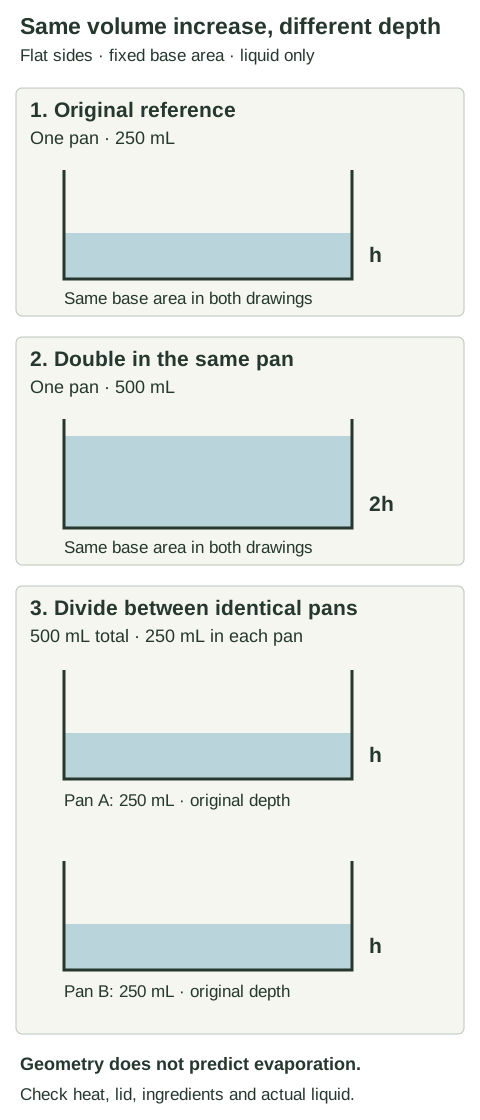
Do not use the sketch to halve every doubled liquid amount. Burner output, exposed surface, lid position, ingredient moisture and cooking duration influence what you observe. A larger pot can have a different base area; a deeper load can also change stirring and heating. Record the actual arrangement rather than assigning an unmeasured evaporation rate.
Follow the recipe’s liquid stage, keeping suitable extra water or unsalted stock available if it calls for adjustment. Measure each addition. If the sauce needs reduction but the vegetables or noodles have reached their intended texture, protect them while finishing the sauce separately when practical.
Liquid adjustment changes seasoning and texture together. More water can dilute a sauce, but it does not remove sodium already added. More starch can thicken a liquid without restoring the original flavor or overcooked vegetables. Use the slurry guide for its separate mixing and portion checks.
Keep the total meal quantity separate from each batch
A factor-three shopping list does not require a factor-three load in one wok. One possible allocation is three original-size batches. Each receives one original share of ingredients; the totals still add to the six-portion baseline. Whether that arrangement suits your equipment and service depends on the actual recipe.
Write an allocation before heating. Put measured sauce portions into separate clean containers if that helps avoid using all the sauce in the first batch. Keep raw and cooked food tools separate. Do not use an unremixed slurry bowl as though every spoonful had the same starch proportion.
| Record field | Original reference | Planned or invented record | What the record establishes |
|---|---|---|---|
| Recipe yield | 2 portions | 6 portions | Factor 3; preserve the intended portion size. |
| Cooking arrangement | One original-size batch | Three separate original-size batches | A proposed allocation, not a tested capacity guarantee. |
| Noodles / pork per batch | 100 g / 150 g | 100 g / 150 g in each of three batches | Totals: 300 g noodles and 450 g pork. |
| Baseline water per batch | About 250 mL | About 250 mL in each batch | Total baseline: about 750 mL. |
| Illustrative extra water | Not specified | Batch 1: 20 mL; batch 2: 0; batch 3: 10 mL | Invented record: 30 mL extra, 780 mL added in total. |
| Final observation | Write after cooking | Texture, liquid remaining, seasoning, safe endpoint | Do not fill these fields with assumed success. |
The extra-water numbers in this table are invented to show accounting. They are not a recommendation to add 20 mL to a first batch or a report of cooking trials. In this fictional record, about 750 mL baseline plus 30 mL extra means about 780 mL added. It does not establish the amount left in the finished food.
Batch two may behave differently because of residue, pan recovery or ingredient condition. Preserve the same starting quantities where practical, then write any adjustment against that batch. See the small-stove stir-fry guide for ingredient order and moisture observations.
Preserve the method and check safe cooking in each batch
Ingredient quantities can multiply while a cooking stage stays similar, becomes longer or needs a different arrangement. Do not multiply every timer by the yield factor. Follow the actual batch, recipe sequence, cookware instructions and ingredient endpoint.
Prepare measured ingredients before heating. Keep components with different cooking needs in their recipe’s order, and have a clean landing dish ready for completed food. The Serious Eats stir-frying guide emphasizes preparation and manageable home-stove loads. It does not establish the capacity of your pan.
For the ground-pork example, FDA safe-handling guidance lists 160°F / 71°C, checked with a food thermometer. Poultry requires 165°F / 74°C; the ground-pork rule is not a substitute for it. Measure the actual food with a suitable probe rather than the sauce or pan, and keep raw-food contact away from cooked food.
A larger cooking session also needs a leftover plan. FDA advises refrigerating perishables within two hours, or one hour above 90°F / 32°C, and dividing larger amounts into shallow containers for quicker cooling. Do not leave a large batch on the counter until it feels completely cool. Reheat leftovers to 165°F / 74°C.
Finish each meat batch safely in the cooking session. Surface browning and sauce gloss are texture observations, not clearance to store partially cooked meat for another day. If long holding is required, use an appropriate safe holding method instead of extending a countertop landing step.
Eight scaling decisions with explanations
These original cases use stated quantities and simplified assumptions. Work out the yield factor, batch allocation or next useful check before opening the explanation. The invented liquid additions and label values are not recipe trials.
Case 1
A recipe makes two portions at your usual portion size. You want six of the same size. What factor applies to its measured ingredient quantities?
Show answer and explanation for case 1
Three: 6 divided by 2.
Multiply each measured quantity by three to make the planning baseline. This does not make the pan three times larger or establish a cooking time. The original noodle example becomes 300 g dried noodles and 450 g ground pork.
Case 2
A fictional recipe yields four portions of 200 g each. You need six portions of 150 g each. Is the factor 6 divided by 4?
Show answer and explanation for case 2
No. The total-yield factor is 900 divided by 800, or 1.125.
The portion sizes change. Original total yield is 4 × 200 = 800 g; required total is 6 × 150 = 900 g. A 100 g measured ingredient has a 112.5 g baseline. This arithmetic assumes those stated yields; it does not predict cooking losses.
Case 3
You double a familiar recipe, using the same brands and keeping portion sizes the same. Someone says salt must always stay at the original amount. Is that a reliable general rule?
Show answer and explanation for case 3
No. Use a quantity baseline and a controlled finishing check.
Doubling the food and total portions can justify a proportional seasoning baseline. The practical result can still change with reduction, ingredient moisture, substitutes and optional salt. Keep adjustable finishing seasoning available separately rather than adopting a universal half-salt or 75-percent rule.
Case 4
A fictional label lists 600 mg sodium per 15 mL. The original sauce amount is 15 mL for two equal portions; the doubled amount is 30 mL for four equal portions. If all sauce is retained and distributed evenly, what changes?
Show answer and explanation for case 4
Sauce sodium doubles from 600 to 1,200 mg; its estimated contribution stays 300 mg per portion.
The ingredient quantity and portion count both double. This is a hypothetical label calculation for that sauce only, not a real product analysis or a taste prediction. Other salty ingredients and the amount actually eaten matter. The label’s serving unit must match the quantity measured.
Case 5
A simplified flat-sided pan contains a 250 mL liquid layer. You put 500 mL into the same pan with the same base area. What does the geometry establish?
Show answer and explanation for case 5
The idealized liquid depth doubles; it does not establish an evaporation rate.
For this schematic, volume equals base area times depth. Real cookware can have sloped sides, food displaces liquid, and heat, lid position and cooking time also matter. Do not infer that water should be halved or that cooking time should double from this diagram.
Case 6
You prepare three original-size batches with about 250 mL baseline water each. Your invented actual record adds another 20 mL, 0 mL and 10 mL. What liquid quantity was added?
Show answer and explanation for case 6
About 780 mL in total: 750 mL baseline plus 30 mL extra.
The separate batch record makes the adjustment visible. It does not say 780 mL remains in the finished food: absorption, released ingredient moisture, evaporation and any discarded liquid are separate questions. The invented additions are an accounting example, not a recommended dose.
Case 7
The recipe is tripled. Should its stated six-minute cooking stage automatically become eighteen minutes?
Show answer and explanation for case 7
No. Retain the recipe’s sequence and check the actual batch and safe endpoint.
Yield conversion is ingredient arithmetic. Equipment, depth and the amount handled at once can change cooking behavior. Three original-size batches take extra session time, but each is not automatically assigned a tripled timer. Use suitable texture checks and a food thermometer for meat safety.
Case 8
The larger cooked sauce tastes too salty. Will adding unsalted water erase sodium already added?
Show answer and explanation for case 8
No. It dilutes the liquid but does not remove the added sodium.
A compatible small liquid adjustment can change concentration and texture; it can also make a noodle dish too wet. Protect finished ingredients while adjusting where practical, stop overlapping salty additions, and record a lower starting quantity for the next batch. This is not a guaranteed rescue or a complete nutrition calculation.
Keep a planned-versus-actual record for the next attempt
Download the recipe scaling quantity worksheet. It includes blank ingredient rows, a per-batch liquid and seasoning log, the example calculations, all eight questions and full explanations. Use it alongside the complete recipe.
Recipe, link and original yield:
Required yield and intended portion size:
Conversion factor and matching units:
Exact ingredient products and preparation:
Container, batch count and lid arrangement:
Each ingredient: original / calculated baseline / actually added:
Each batch: starting liquid / extra liquid / finishing seasoning:
Safe cooking endpoint and actual texture:
Result observed after cooking:
One change to compare next time:
Distinguish a plan from an observation. Leave texture and final-seasoning fields blank until you actually cook. Record a specific change, such as using unsalted stock instead of a salted product, or keeping the same total noodles while dividing the load.
When a repeat batch differs, compare the product, portion size, container and actual additions before changing everything. A useful personal scaled recipe is the one you have adjusted and documented for your own setup. The worksheet gives you a consistent starting record without claiming that one ratio guarantees the same result in every kitchen.
Sources and further reading
- BCcampus: Converting and Adjusting Recipes and FormulasThe BC Cook Articulation Committee: required-yield/original-yield factor, changed portion sizes, measurement consistency and practical seasoning/equipment cautions.
- FDA: How to Understand and Use the Nutrition Facts LabelNutrients refer to the labeled serving quantity. Used only for a clearly hypothetical sauce-quantity calculation, not a real bottle analysis or dietary prescription.
- Serious Eats: Wok Skills 101 — Stir-FryingTim Chin and J. Kenji López-Alt: preparation, manageable home-stove loads, ingredient sequence and measured sauce finishing. No universal batch limit or measured evaporation claim.
- FDA: Safe Food HandlingClean/separate handling, thermometer-based cooking endpoints, prompt refrigeration and shallow containers for larger leftover quantities.
Changing the noodle as well as the quantity?
Recipe scaling keeps the same recipe basis. If the replacement starts fresh instead of dried, record its cooked-and-drained yield before comparing portions.