Practical guide
Plan Two Stir-Fries and Rice on One Burner
On one burner, schedule the heating jobs in sequence and prepare everything before the fast pan stages. An off-heat rest can overlap only when the actual recipe permits it and you have safe space for the pot. Finish the more time-sensitive dish nearer serving, using clean landing dishes and keeping raw ingredients chilled until needed.
Make a job list from the complete recipes
Two dishes that each say “ten minutes” do not necessarily make a ten-minute meal. They may need the same burner, the same pan and your attention at the same time. Rice preparation, sauce mixing and cleaning between raw and cooked work also occupy real space or time.
Read each full recipe before selecting the menu. Mark preparation, burner use, an explicitly permitted off-heat rest, the last texture-sensitive finish and the serving or storage plan. The Woks of Life fried-rice method prepares its sauce before the pan stage; its steaming guide emphasizes having a workable vessel, clearance and enough water. Those are reasons to plan the setup, rather than discover it while food cooks.
Use the small-stove guide for moisture, component order and manageable loads within one dish. Here the question is which complete dish gets access to the burner and to the cook next.
Identify the resources that cannot overlap
| Job property | Question to answer | Planning consequence |
|---|---|---|
| Burner | Does this stage need the only heat source? | Two heating blocks cannot occupy it together. |
| Cook attention | Does this stage need stirring or a safety check? | An available burner does not create a second cook. |
| Pot and landing space | Can a pot rest safely off heat by its recipe? | Only an allowed rest frees the burner. |
| Raw food | Which board, tools and storage does it need? | Keep chilled and separate; plan cleanup before ready food. |
| Texture at serving | Which dish loses its intended texture while waiting? | Consider finishing that dish last, within safe handling. |
| Long wait | Can the recipe be safely held, chilled or reheated? | Choose a verified plan or simplify the menu. |
A practical first menu has fewer competing final stages. Two quick dishes may be harder to coordinate than one quick dish plus a component already safely prepared. This is an editorial planning choice, not a guarantee that a particular recipe tolerates a long wait.
Work through an original one-burner schedule
| Job | Hypothetical duration | Dependency / resource |
|---|---|---|
| R: rice heating block | 18 min | Only burner; after preparation |
| O: permitted off-heat rice rest | 10 min | After R; safe pot space; no burner |
| A: vegetable dish A | 7 min | After preparation; only burner |
| X: suitable pan reset | 2 min | After A; before B; cook attention |
| B: quick dish B | 4 min | After X; only burner |
| Serve | No assigned duration | After O and B; prompt service |
Every duration is invented for this scheduling exercise. No actual rice packet or dish is instructed to cook for these times. Replace the jobs and dependencies with the recipes and cookware you use. An off-heat rest is available only if the real recipe gives that step.
- Do preparation first, with no clock total promised.
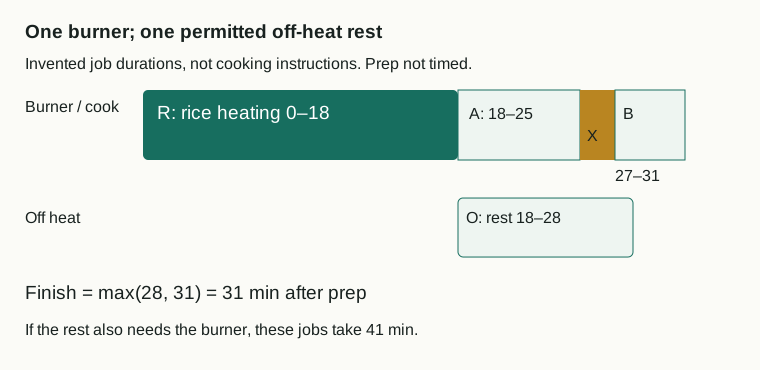
- R occupies minute 0–18. O then runs 18–28 off heat.
- A occupies the burner 18–25. X uses attention during 25–27.
- B occupies the burner 27–31. Both B and the rice rest are complete at minute 31.
The fictional heating/rest plan takes 31 minutes after preparation. Simply adding every duration gives 41 minutes, but the permitted rest overlaps ten minutes of other work. Dish A finishes six minutes before service; the rice rest finishes three minutes before it. These are scheduler facts, not clearance for a food’s holding method or a prediction of quality.
Check what changes when one constraint changes
If that real rice recipe has no safe off-heat rest, do not borrow O from the illustration. If O also occupies the only burner, the same fictional jobs become sequential: 18 + 10 + 7 + 2 + 4 = 41 minutes. The extra ten minutes are a resource conflict, not slower cooking caused by a weak stove.
If preparation is unfinished at minute 18, the pan plan must wait. Chopping garlic while a fast final stage runs is not free overlap. If dish A cannot tolerate the planned service interval, change the order, use an appropriate holding arrangement or choose another dish. Do not solve a scheduling problem by leaving partially cooked meat for later.
Reset the pan by its own instructions. Moving a hot pot requires a stable heat-safe landing place; washing or cooling cookware abruptly is not automatically an acceptable two-minute reset. X is a fictional time slot, not a procedure.
Keep handling and cooking endpoints in the plan
FDA guidance separates raw meat, poultry, seafood and eggs from ready-to-eat food, including using clean plates for cooked food. Keep waiting perishables appropriately refrigerated. Prepare sauces and vegetables with clean tools before or separately from raw-food work.
A dish occupying its assigned block still needs its food-specific safe endpoint. FDA lists 160°F / 71°C for ground meat and 165°F / 74°C for poultry and leftovers, checked with a suitable thermometer. Surface browning or reaching minute 31 cannot establish that endpoint.
Serve promptly. For leftovers, FDA calls for refrigeration within two hours, or one hour above 90°F / 32°C, and dividing larger amounts into shallow containers. For rice, the FSA’s household guidance for England, Northern Ireland and Wales advises quick chilling ideally within one hour, refrigerator storage no more than one day before reheating and reheating only once. A pot’s recipe rest and safe leftover cooling are different stages. Follow an appropriate local and product-specific plan if service is delayed.
Four original scheduling checks
Use the stated fictional jobs, not remembered recipe times.
Case 1
R takes 18 minutes; O rests off heat for 10. A, X and B need 7, 2 and 4 minutes after R. When are O and B both finished?
Show answer and explanation for case 1
Minute 31 after preparation.
O ends at 28; A ends at 25, X at 27 and B at 31. Service depends on both O and B.
Case 2
O actually needs the only burner. Can A still begin at minute 18?
Show answer and explanation for case 2
No. The fictional sequential plan becomes 41 minutes.
Without the allowed off-heat overlap, the jobs occupy 18 + 10 + 7 + 2 + 4 minutes.
Case 3
The sauce for B is still unmeasured while B’s fast pan stage begins. Is that preparation time already included in the 31-minute result?
Show answer and explanation for case 3
No. Preparation has no assigned duration in this example.
Add the actual preparation job or finish it first. The timeline never establishes total meal time including prep.
Case 4
Poultry has brown edges when its scheduled block ends. Is the scheduler a doneness check?
Show answer and explanation for case 4
No. Confirm the food-specific safe temperature.
FDA lists 165°F / 74°C for poultry. A timetable does not measure the interior.
Build your next plan from the recipes you actually use
Download the one-burner meal worksheet. Put the recipe links beside the jobs, write which stages need the burner and which need attention, then draw the dependencies. Record actual completion and service times after cooking. Adjust one conflict in the next session instead of assuming the illustrative minute numbers fit your kitchen.
Sources and further reading
- The Woks of Life: Pork Fried RiceMeasured sauce preparation before heating; no site recipe or tested schedule copied.
- The Woks of Life: How to Steam FoodSetup, water and vessel clearance before steaming; no universal cooking duration adopted.
- FDA: Safe Food HandlingSeparation, food-specific thermometer endpoints and prompt refrigeration.
- FSA: Home food fact checker, updated 21 August 2026Rice storage/reheating section; stated England, Northern Ireland and Wales scope. Other food sections not applied to these dishes.