Practical guide
Stir-Frying on a Small Stove: Batch Size and Moisture Control
Prepare before heating, dry washed vegetables and cook a load the hot part of your pan can handle. Separate ingredients with different cooking needs, use a clean landing plate for completed batches, and finish with measured sauce. Follow the original vegetable sequence diagram, eight observation checks and six practice cases to decide what to change when food steams or sauce pools. Check meat safety with a thermometer rather than its surface color.
Read the water in the pan before blaming the stove
A small stove has less room for error when a large cold, wet load enters the pan. Several things can create a watery simmer: surface water left after washing, moisture released by mushrooms or zucchini, frozen meltwater, a deep overlapping layer, or a large sauce pour. Check those causes together before changing equipment.
A stir-fry can include a deliberate steaming or sauce stage. Water in the pan is therefore not automatically a failure. Ask whether the current stage should be browning, cooking vegetables through or coating finished ingredients. A recipe for tender greens in sauce has a different target from seared mushrooms.
The Serious Eats stir-frying guide, by Tim Chin and J. Kenji López-Alt with advice from wok specialists, emphasizes preparation, dry vegetables, cooking order and limits of ordinary home ranges. Use those principles to plan your load. The checks below are a method guide and original planning examples; they do not establish a kitchen-tested batch capacity for your stove.
Prepare the ingredients and decide what fits at once
| Component | Prepare first | What to account for |
|---|---|---|
| Washed vegetables | Dry surface water; cut for the recipe’s cooking sequence. | Mushrooms, zucchini and greens can still release water from inside. |
| Frozen vegetables | Use the product or recipe’s thawing/cooking method; manage meltwater. | Extra ice entering a small pan changes the load. |
| Raw meat or poultry | Prepare as the recipe directs; keep chilled and separate from ready food. | A crowded wet layer can lose browning; safety still needs a thermometer. |
| Sauce and slurry | Measure before heating; keep the slurry mixed immediately before use. | A large pour changes both liquid amount and seasoning. |
| Landing plate and tools | Have clean space for completed batches and separate raw-food utensils. | A raw-meat plate is not a clean place for cooked food. |
Use the hot working area of the pan, not the height of its walls, to assess a batch. Food piled above other food may not contact that area. Start with a manageable arrangement that gives pieces room to cook, then observe the response before adding more. There is no single gram limit that suits every pan, stove and ingredient.
When a recipe is doubled, keep the meal quantity separate from the amount cooked at one time. You may need extra batches and a longer cooking session. Prepare that landing space before heating so you can move completed food without using the raw-food plate or searching for a dish.
Use cookware compatible with your heat source and follow its heat and preheating instructions, especially for coated pans. A professional bare-metal wok routine does not automatically apply to every home pan. Manage load and water within those instructions rather than trying to make the pan visibly smoke.
Follow the original vegetable batch-sequence diagram
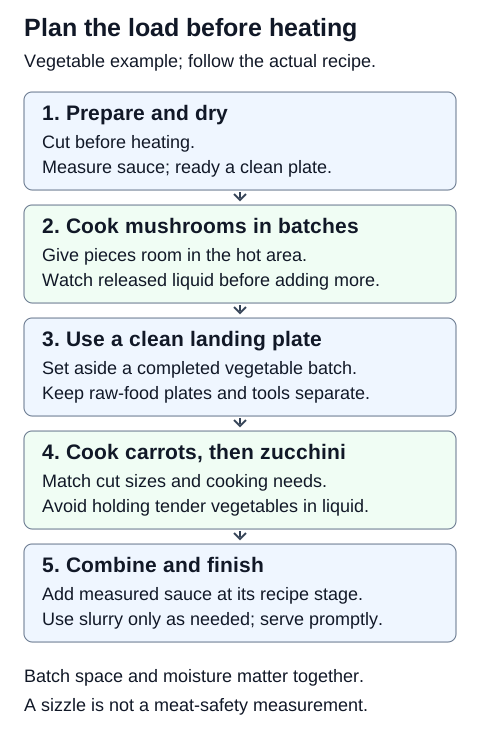
This arrangement separates the mushroom moisture stage from the zucchini’s shorter finish. The clean landing plate allows a completed batch to wait briefly during the same continuous cooking session. It is not a plan to leave cooked food on the counter for hours.
Ingredient order can differ in another recipe. Follow that dish’s method, including any appropriate blanching or pre-cooking step. Dense carrots, leafy greens and ground meat are not interchangeable components that can all be tossed in at once.
Apply the plan to mushrooms, carrots and zucchini
The mushroom, zucchini and carrot recipe provides the ingredient amounts and starts by browning mushrooms before carrots and zucchini enter. Use it as a specific dish, then adapt the amount handled at once to your pan.
Wash the vegetables before cutting and dry surface water. Keep zucchini pieces substantial enough for that recipe’s intended texture and carrots appropriately thin. Have the sauce measured and the optional slurry ready before the first hot-pan step. Drying does not remove water naturally held inside a mushroom or zucchini, so still watch the cooking stage.
Give the mushrooms room and let the recipe’s moisture stage develop. If the pan cannot handle all of them well at once, use separate batches rather than adding zucchini on top of a wet pile. Move a completed vegetable batch to a clean plate when needed. Then follow the carrot and zucchini sequence, checking their different textures.
For this dish, garlic and seasoning enter late. Do not make garlic wait through the whole mushroom moisture stage. Combine the prepared components for the finish and add the measured sauce at the specified stage. Decide whether the optional slurry is needed from the actual juices and target coating. A thicker sauce cannot restore zucchini that has already collapsed.
Eight observations and a controlled next move
| What you see | Check first | Controlled next move | What it does not prove |
|---|---|---|---|
| Sizzle becomes a persistent watery simmer | Surface water, released juices, frozen meltwater and batch size. | Stop adding ingredients; plan a smaller next batch and protect vegetables already tender. | That every case has the same cause. |
| Mushrooms are pale in a deep pile | Overlap and liquid underneath the pile. | Give a smaller batch space; let the recipe’s moisture stage finish before adding zucchini. | That adding more oil will remove the water. |
| Garlic darkens before the vegetables are ready | Heat level, ingredient order and time waiting in the pan. | For the next batch, add garlic at the recipe’s later stage and regulate the heat. | That water or starch will erase burnt flavor. |
| Carrots are hard while zucchini is soft | Piece thickness and different cooking needs. | Cut carrots appropriately or pre-cook them by a suitable method; shorten zucchini’s finish. | That all vegetables should share one timer. |
| Liquid pools after sauce enters | How much sauce was poured and how much vegetable water remains. | Check the sauce separately when practical; add less reserved sauce next time if the recipe allows. | That the full prepared slurry is needed. |
| The sauce turns gummy | Cumulative starch dose and remaining liquid. | Stop starch additions; adjust a compatible sauce gradually and reassess seasoning. | That a thicker sauce repairs overcooked vegetables. |
| Protein browns but its center is uncertain | Appropriate internal-temperature measurement. | Complete cooking to the ingredient’s safe endpoint; check actual pieces with a suitable probe. | That a brown surface proves safe cooking. |
| The second batch behaves differently | Pan recovery, residue, changed ingredient moisture or a different load. | Check the pan and repeat the preparation and batch size deliberately. | That the stove became stronger or weaker from one observation. |
A single observation often has several possible causes. If a smaller batch works differently, that is useful information about this cooking setup; it does not prove an exact wattage requirement or that the previous load was the only variable.
Between batches, check the pan’s condition and let it recover appropriately within its instructions. Residue, a new wet ingredient or a different load can change what happens next. Do not add every remaining ingredient merely because the first batch has left an empty space.
Separate sauce adjustment from vegetable cooking
Measure sauce before heating. Adding bottles one by one while food cooks makes it harder to track liquid and salt. On a small stove, a large cold pour can also change the pan from a searing stage to a simmering stage. Use the amount and timing specified for your dish.
Some moisture is intentional: tough vegetables may need a suitable covered cooking step, and a sauce may need liquid to distribute. Judge the stage and target texture before deciding the dish is too wet. For a light coating, keep the liquid and starch decisions controlled rather than making a thick glaze hide a crowded pan.
When practical, protect vegetables already at their target texture while finishing the sauce separately. Remix slurry immediately before using it, add only an appropriate portion and follow the sauce’s heating step before judging thickness. See the cornstarch slurry guide for mixing ratios, portion tracking and limits. It cannot calculate a universal dose from the amount of water visible in a pan.
If the result is burnt, badly overcooked or has been handled unsafely, more starch is not a reliable recovery method. For the next attempt, change one relevant factor—such as surface drying or load—while keeping the recipe and other conditions clear.
Keep meat safety and batch holding separate from browning
| Ingredient category | Minimum endpoint | How to use the check |
|---|---|---|
| Chicken and other poultry, including ground poultry | 165°F / 74°C | Use a food thermometer; browning and clear sauce are not the check. |
| Ground beef, pork, lamb and veal | 160°F / 71°C | Do not transfer a partially cooked batch for later storage. |
| Beef or pork steaks, roasts and chops | 145°F / 63°C, then at least 3 minutes rest | This is the listed whole-cut category; it does not replace the ground-meat rule. |
| Reheated leftovers | 165°F / 74°C | Check the food, not only the surrounding sauce or pan surface. |
The FoodSafety.gov temperature chart requires a food thermometer for meat safety. Use a probe suitable for the actual pieces and follow its measurement instructions. Do not measure only the surrounding sauce, the pan surface or an arbitrary pile of thin meat. A brown edge and a sizzling sound are texture observations.
For this simple batch plan, complete safe meat cooking in the current session and keep raw-food tools separate from cooked food. It is not a method for storing partially cooked poultry to finish another day. Keep perishable ingredients appropriately chilled while waiting for their turn.
USDA’s leftovers guidance says to refrigerate leftovers within two hours, or within one hour when the ambient temperature is above 90°F / 32°C. Divide larger amounts into shallow containers for rapid cooling; hot food can go directly into the refrigerator. Do not wait for a large batch to cool completely on the counter.
USDA lists refrigerated leftovers for three to four days and reheating to 165°F / 74°C. A short same-session landing step does not replace those handling requirements. If you need an extended holding period, plan an appropriate safe hot- or cold-holding method rather than treating the countertop as part of the recipe.
Six practical batch and moisture decisions
These invented cases help you choose the next check. They are not results of cooking trials performed by this site. Apply the actual recipe and cookware instructions before changing heat or ingredient quantities.
Case 1
You double a vegetable recipe but keep the same small pan. The food sits in several overlapping layers and the pan fills with liquid. Which change comes first?
Show answer and explanation for case 1
Reduce the load handled at once and separate the components by cooking need.
Doubling the ingredients does not double the hot area or the stove’s ability to recover after a wet addition. Keep the total meal quantity if needed, but cook manageable batches and use a clean landing plate for completed vegetables. Also dry washed produce and check whether frozen ingredients add meltwater. A smaller load is a useful change to investigate, not proof that batch size was the only cause. Record the new batch arrangement and observe the liquid before changing the oil, sauce and heat setting at the same time.
Case 2
The mushrooms have released liquid and the zucchini is already tender. Should you leave both cooking until the pan is completely dry?
Show answer and explanation for case 2
Protect the tender zucchini and deal with the remaining liquid separately when practical.
Evaporating liquid while delicate vegetables stay in the pan can push their texture further past the target. Move completed vegetables to a clean plate if practical, then evaluate the sauce or juices without continuing to cook them. Use a suitable recipe for the desired finish; a burnt or badly overcooked result has no guaranteed repair. Next time, finish the mushroom moisture stage before adding zucchini, and use a manageable load. The target is a controlled dish, not making every ingredient wait until there is no liquid anywhere.
Case 3
A chicken batch has brown edges after a short sear. Can it be set aside for tomorrow and finished then?
Show answer and explanation for case 3
Complete safe cooking in the current session; browning is not a storage or doneness check.
This batch plan is not a method for storing partially cooked chicken. Cook poultry to 165°F / 74°C as checked with a suitable food thermometer, use clean tools and a clean plate for cooked food, and handle any leftovers promptly. A brown edge reports a surface change, not the temperature reached inside the pieces. For thin or small pieces, use an appropriate probe and its measurement instructions rather than reading the hot pan or a convenient pile of food. Texture decisions never replace the actual safety endpoint.
Case 4
Frozen vegetables bring visible ice into the pan. Someone says the only solution is to turn the burner beyond the pan’s recommended heat. Is that a useful plan?
Show answer and explanation for case 4
Manage the ingredient’s water and batch method within the pan’s instructions.
Follow the package or recipe’s thawing or cooking method, and account for meltwater entering the pan. Some recipes deliberately steam vegetables first; that is different from expecting a dry sear while a large icy load melts. Do not exceed the cookware’s instructions to compensate for a wet batch. Choose a smaller load or an appropriate staged method, then evaluate what happens. The observation does not prove the pan needs replacement, a fixed higher setting or a professional burner to make an acceptable home meal.
Case 5
A large sauce pour makes the stir-fry soupy. You have a full bowl of slurry ready. Should it all go in immediately?
Show answer and explanation for case 5
Check liquid and the desired coating before adding a controlled portion of remixed slurry.
The mixture you prepared is not automatically the dose the pan needs. Released vegetable water and the sauce pour may already have changed the intended liquid amount and seasoning. Follow a suitable sauce method, protect tender vegetables while adjusting when practical, and judge thickness after the required heating step. More starch can turn a diluted sauce gummy without restoring the vegetables or the original flavor balance. Keep the cumulative addition visible and use the separate slurry guide for ratio and portion checks.
Case 6
Garlic begins to burn while thick carrot pieces remain hard. Will more stirring solve both problems?
Show answer and explanation for case 6
Change the cooking sequence and carrot preparation; stirring cannot reverse burnt garlic.
The ingredients need different treatment. Use the recipe’s carrot cut or an appropriate pre-cooking step, and add garlic at a stage where it can flavor the dish without waiting through the carrot’s full cooking period. Regulate heat within the cookware’s instructions. Constant movement can redistribute food, but it cannot give every ingredient the same cooking requirement or reliably remove scorched bitterness. For a new batch, change the cut and sequence deliberately rather than repeating the same timing with faster hand movement.
Download the batch review sheet and change one factor
Download the batch-sequence SVG or the small-stove stir-fry review sheet. The sheet includes the preparation table, eight observation checks, selected safety endpoints and all six practice explanations.
Record the recipe, pan, stove setting, ingredient condition, amount handled per batch, component order and sauce addition. Note where liquid first appeared and what texture you wanted at that stage. A useful note is specific enough to compare with a later attempt.
For a repeat session, choose one change that addresses the observed problem. Dry the washed vegetables more thoroughly, reduce a load, revise a cut to match the recipe, or hold tender vegetables out of a sauce adjustment. Keep other conditions as consistent as practical. This is a personal cooking record, not a claim that a fixed batch size has been scientifically validated.
Sources and further reading
- Serious Eats: Wok Skills 101 — Stir-FryingTim Chin and J. Kenji López-Alt: dry vegetables, home-range load limits, preparation, ingredient sequence and sauce timing. No professional temperature target, torch method or universal batch weight adopted.
- FoodSafety.gov: Cook to a Safe Minimum Internal TemperatureThermometer checks, separate poultry and ground-meat categories, whole-cut rest requirement and reheating endpoints.
- USDA FSIS: Leftovers and Food SafetyPrompt refrigeration, two-hour/one-hour ambient limits, shallow containers, direct refrigeration of hot food, three-to-four-day storage and reheating to 165°F.
Planning more than one dish?
After choosing a manageable load for each dish, put the whole meal’s burner jobs and dependencies in order. The worksheet keeps preparation and a permitted off-heat rest separate.