Practical guide
Black Bean Chicken Sauce Packet vs Douchi: Choose One Sauce Method
Loose douchi, a mixed jar and a black-bean chicken pouch are different formats. This named 50 g pouch already includes soy sauce, aromatics and anchovy extract. Its manufacturer recipe uses one pouch with 12 ounces of chicken and fresh aromatics; that recipe does not define a spoon conversion for loose beans.
On this page
Identify loose beans, jar or meal pouch
Read the format before measuring. Douchi are individual salted fermented black soybeans. A chili black-bean jar is a mixed condiment. A menu-oriented chicken pouch is another mixture with a complete named use. All three can provide a fermented direction, but equal spoonfuls do not represent equal quantities of beans or seasoning.
The existing douchi guide covers identifying, rinsing when specified and chopping loose beans. The decision here is different: whether to use a complete pouch method or build a sauce from individual ingredients.
Read what the pouch already includes
On a phone, scroll inside the table. Keyboard users can focus the table region and use arrow keys.
| Format | Published ingredients | Decision that follows |
|---|---|---|
| Sauce for Black Bean Chicken, 50 g pouch | Soy sauce with wheat, fermented black beans, sugar, garlic, chili, ginger, oil, anchovy fish extract, rice wine and modified corn starch | Contains more than beans; soybeans, wheat and anchovy declared. |
| Chili Black Bean Sauce jar | Fermented soybean paste with wheat, oil, chili, fermented black beans, shallots, garlic, sesame oil and other seasonings | A chili/oil/bean condiment, not the named chicken pouch. |
| Loose douchi | Individual fermented black soybeans; check the exact packet | Measure and prepare the quantity required by the chosen recipe. |
The pouch’s fish ingredient is easy to miss if you only read “black bean.” It is not a vegetarian or fish-free shortcut. Nor does a jar’s similar name establish the same formula as the pouch. Check the current package, including its regional version.
Trace the published chicken sequence
The manufacturer’s Black Bean Chicken Recipe uses 12 ounces chicken pieces, one pouch, six shallots, two ginger slices and two scallions. It lists four tablespoons oil split between an initial tablespoon for chicken and three tablespoons for the aromatics and sauce. Those details belong to that exact recipe; they are not quantities for every home batch.
The chicken is first sautéed and set aside. The shallots, ginger and sauce are then sautéed, followed by the chicken returning to finish cooking and scallions added at the end. Setting it aside after the initial golden-yellow stage is an intermediate step, not proof of safe doneness.
Use a suitable thermometer to confirm chicken reaches 165°F, about 74°C. Keep the raw-contact board and utensils away from ready rice and garnish. The manufacturer’s estimated ten-minute cooking time cannot establish an endpoint for a larger piece or a different pan.
Avoid stacking two seasoning formulas
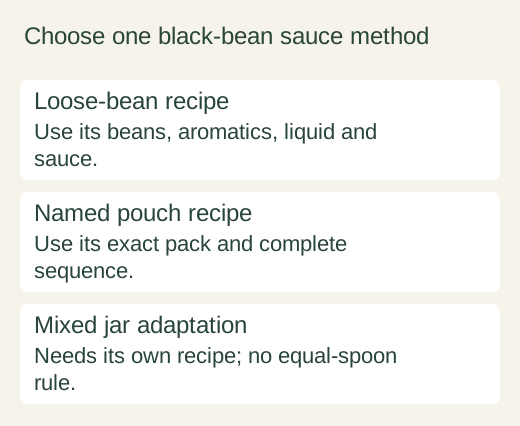
Download the labelled decision diagram
If you add a full pouch to a recipe that already contains measured douchi, soy sauce, oyster sauce and stock, you have combined two systems. The mixture can gain salt, sweetness, liquid and thickener together. You cannot deduce how to subtract each ingredient from the names alone.
Choose the named pouch method or a complete loose-bean method. If you want an adaptation, use a recipe that explicitly supports your product and record its measures. Do not fix an unknown conversion by repeatedly adding more soy, and do not assume every sauce needs the same garlic addition.
Check fish ingredients and food handling
A vegetable substitute for chicken still leaves the anchovy-containing sauce in this specific pouch. A fish-free meal needs a suitable condiment as well as a suitable main ingredient. Wheat and soy requirements need separate checks too; neither fermentation nor a small portion removes an ingredient from the decision.
Follow the exact storage directions after opening. Cooked meals still need prompt refrigeration: within two hours, or one hour above 90°F, about 32°C. FDA advises shallow containers for quicker cooling and 165°F, about 74°C, for reheated leftovers. The fermented beans do not preserve the cooked chicken meal.
Source details: [4].
Three explained black-bean decisions
These cases illustrate reading and cooking decisions; no sensory comparisons were performed.
Case 1
A component recipe asks for 1 tablespoon douchi. Can a 50 g chicken pouch replace that spoon without changing anything else?
Show answer and explanation for case 1
No universal conversion is supported.
The pouch mixes beans with several other ingredients and its whole-pack quantity belongs to a different complete chicken method. Choose the method before the amount.
Case 2
You cook mushrooms instead of chicken with this named pouch. Is the result automatically vegetarian?
Show answer and explanation for case 2
No. The pouch lists anchovy fish extract.
Replacing the protein does not replace the sauce ingredients. Select a confirmed suitable condiment and complete method for the meal.
Case 3
Chicken is golden yellow during the first sauté. Is it safe to serve before the later sauce stage?
Show answer and explanation for case 3
Color is not the safety endpoint.
This recipe still returns chicken to finish cooking. Confirm 165°F with a suitable thermometer and handle the intermediate chicken and its utensils safely.
Sources and further reading
- Lee Kum Kee USA: Sauce for Black Bean ChickenNamed US product ingredients and stated uses, checked November 11, 2026. Regional formulas and your current package can differ.
- Lee Kum Kee USA: Chili Black Bean SauceNamed US product ingredients and stated uses, checked November 11, 2026. Regional formulas and your current package can differ.
- Lee Kum Kee USA: Black Bean Chicken RecipePublished recipe used to examine its sauce components and sequence; missing or ambiguous quantities are discussed where relevant. Attributed amounts are not a general substitution ratio.
- FDA: Safe Food HandlingFood handling, safe cooking endpoints, refrigerated marinating and prompt cooling. FDA document captured November 7, 2026.