Practical guide
Broccoli Beef Ready Sauce vs Oyster Sauce: Avoid Mixing Two Formulas
A broccoli-beef ready sauce already combines several seasonings and thickeners. Use the complete recipe for that exact product or a separately measured oyster-soy method. The named sauce also contains oyster ingredients and milk flavor, and its noodle recipe uses a specific 8-ounce pouch rather than a spoon-for-spoon oyster-sauce swap.
On this page
Pick the recipe system
A ready sauce offers a combined seasoning step. A component recipe asks you to measure soy, oyster sauce, wine, liquid and possibly starch separately. Neither system is automatically better; the useful choice is the one with complete directions for the ingredients you have.
Do not add a whole ready pouch to the full component sauce simply because both recipes are called beef and broccoli. That changes several ingredients at once. This guide uses Lee Kum Kee Panda Brand Sauce for Broccoli Beef as a specific example, not a formula for every ready sauce.
Read the ready sauce ingredients
On a phone, scroll inside the table. Keyboard users can focus the table region and use arrow keys.
| Component | Published label example | Check before adding more |
|---|---|---|
| Seasoning | Soy sauce with wheat, oyster extractive, salt and yeast extract | Review other salty sauces; oyster remains an animal ingredient. |
| Sweetness and acid | Sugar, rice vinegar and lactic acid | Do not automatically retain a different recipe’s full sugar and vinegar additions. |
| Wine and oil | Rice cooking wine, sesame oil and other oil ingredients | Alcohol avoidance and sesame requirements need exact-product checks. |
| Body | Modified food starch and xanthan gum | A component recipe’s extra slurry is not automatically needed. |
| Milk information | Natural flavors (milk); milk also appears in the allergen field | A sauce name focused on beef and broccoli does not exclude milk. |
The product’s allergen field lists soybeans, wheat, milk and sesame. Its ingredient list additionally names oyster extractive. Read both fields and the actual package: a short allergen list does not remove an explicitly named oyster ingredient.
Source details: [1].
Trace the noodle and broccoli sequence
The manufacturer’s Broccoli Beef Noodles Recipe lists 1 pound sirloin, 2 cups broccoli, 2 tablespoons neutral oil, one package of rice or egg noodles and one 8-ounce pouch of this ready sauce. It cooks the noodles by their package instructions, blanches broccoli near the end, drains both and combines them with cooked beef and the sauce.
The noodle amount is “one package,” without a verified dry weight in the displayed recipe. Do not turn that into a universal ounce amount or a fixed portion conversion. Read the packet you will actually use, and choose a complete recipe suited to its quantity. Different noodle packages and rice-versus-egg noodle formats cannot be standardized by that wording.
The recipe adds ready sauce after the noodle-and-broccoli drain and beef cook. That is a useful sequencing example, not evidence that an arbitrary sauce can make raw beef safe during a quick final toss. Estimated searing minutes depend on the food and pan.
Source details: [2].
Compare with a component sauce
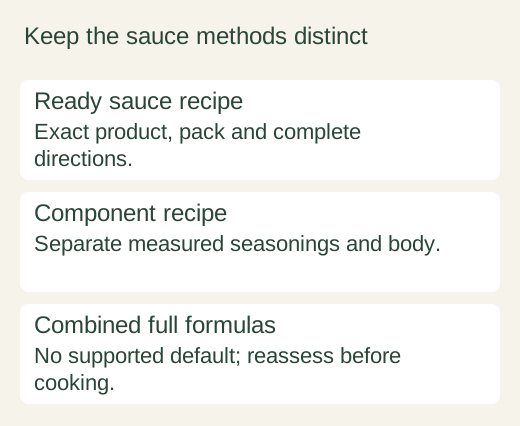
Download the labelled decision diagram
In a component method, oyster sauce supplies flavor, salt, sweetness and body, while soy and wine have separate roles. Our oyster sauce guide explains the supporting uses and vegetarian mushroom replacements. An 8-ounce ready-sauce pack is not an equivalent quantity for one tablespoon of oyster sauce.
If only oyster sauce is available, choose a complete oyster-soy recipe. If only the ready product is available, use its complete exact method. Do not infer substitutions from a photo’s sauce color, or repeatedly add starch to compensate for an unknown seasoning formula.
Check bottle sizes, dietary needs and beef safety
The product page lists an 8-ounce pack and a 14.7-ounce bottle. The noodle recipe names the 8-ounce pack. “One bottle” is therefore not a safe rewrite of “one package” for the sauce either. Keep the exact amount supplied by the complete directions and retain the label.
Vegetables or tofu do not make this oyster-containing sauce vegetarian. A confirmed suitable mushroom sauce can support a different complete vegetarian method; it does not remove milk, wheat or other ingredients from the original product. Egg noodles need their own egg and wheat checks.
For whole-cut beef, FDA guidance gives 145°F, about 63°C, followed by a three-minute rest. Follow the guidance appropriate to the actual cut and preparation; ground beef has a different endpoint. Reheated leftovers reach 165°F, about 74°C. A browned surface, quick cook estimate or glossy sauce does not replace checking safe cooking.
Source details: [3].
Three explained ready-sauce decisions
These are hypothetical checks of product and recipe wording, not cooking tests.
Case 1
A component recipe uses 1 tablespoon oyster sauce. Can you add the full 8-ounce ready pack without reviewing its other seasonings?
Show answer and explanation for case 1
No. Choose a complete method for the ready pack.
It combines multiple ingredients and its full amount belongs to a specific recipe. It is not the equivalent of one measured supporting condiment.
Case 2
The noodle recipe says one package, and your pantry has two differently sized noodle packs. Does the wording settle the same quantity?
Show answer and explanation for case 2
No. The displayed source does not specify a dry weight.
Do not invent a standard package size. Read the actual noodle directions and choose a complete formula that matches its quantity and format.
Case 3
The label says Broccoli Beef Sauce. Can you assume it has no milk or oyster if you cook vegetables with it?
Show answer and explanation for case 3
No. Both appear in this named product’s ingredients.
Meal titles and replacement proteins do not alter a sauce formula. Verify the exact package and every dietary requirement before selecting the meal.
Sources and further reading
- Lee Kum Kee USA: Panda Brand Sauce for Broccoli BeefNamed US product ingredients and stated uses, checked November 11, 2026. Regional formulas and your current package can differ.
- Lee Kum Kee USA: Broccoli Beef Noodles RecipePublished recipe used to examine its sauce components and sequence; missing or ambiguous quantities are discussed where relevant. Attributed amounts are not a general substitution ratio.
- FDA: Safe Food HandlingFood handling, safe cooking endpoints, refrigerated marinating and prompt cooling. FDA document captured November 7, 2026.